ICM
Independent Chip Model - converts chip stacks to prize pool equity.
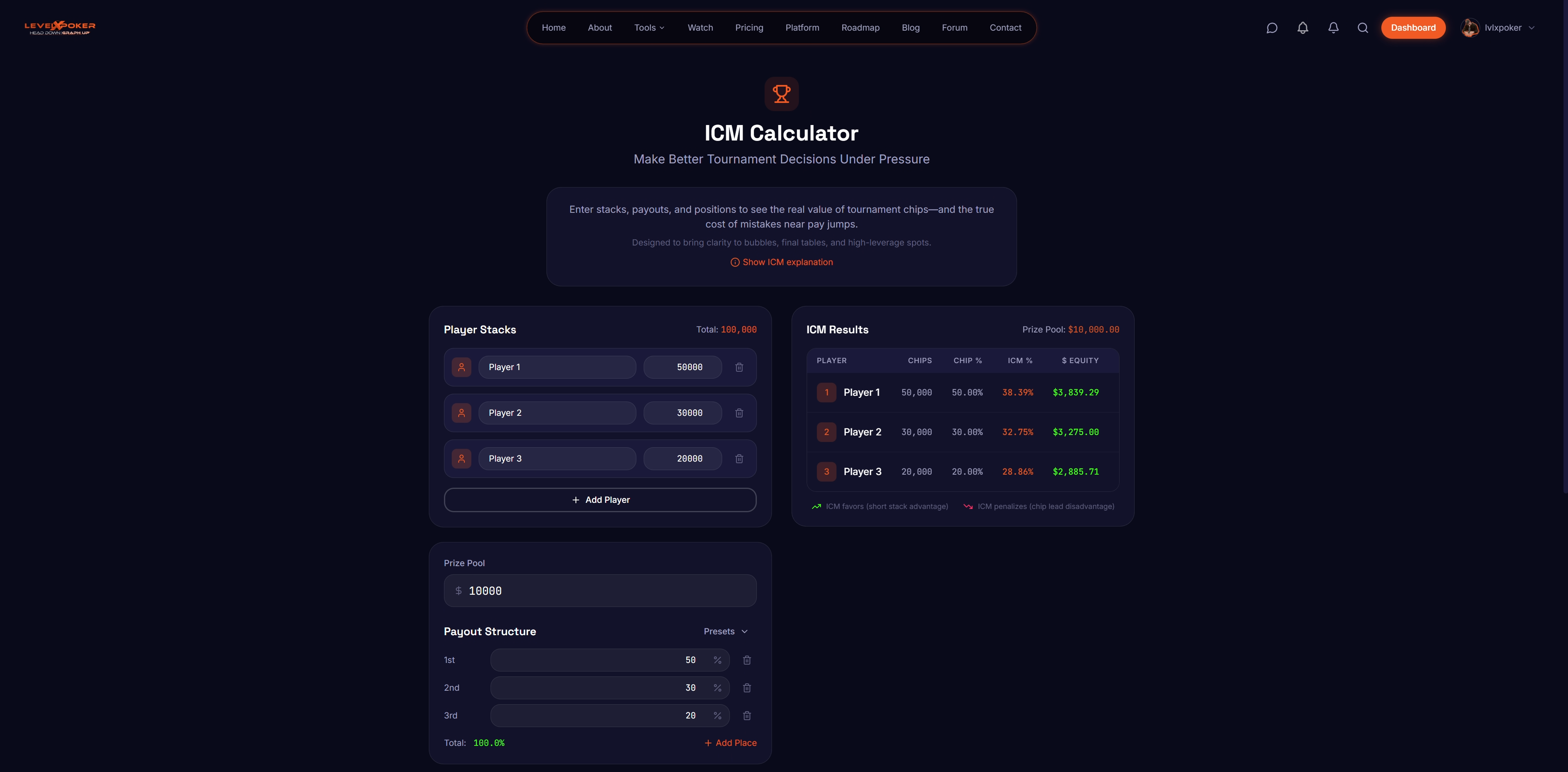
Convert chip stacks to prize pool equity. Make smarter final table and bubble decisions with real tournament math.
Understand tournament equity like never before
Four steps to tournament equity mastery
Input the chip counts for each remaining player
Choose a preset or enter custom prize amounts
Get instant ICM equity for each player
Use the outputs for deal-making or post-session review
ICM changes how you should think about common tournament situations.
You have 25bb on the bubble with 5 left and 4 get paid. The chip leader shoves into you with what looks like a wide range. Chip EV says call with AJo is fine.
Final 3 of a $1000 tournament. Prizes are $4500/$2800/$1700. You have 45% of the chips.
ICM calculations are most valuable when connected to your overall study process.
No. ICM applies anytime payout structure and elimination risk affect chip value - final tables, bubble situations, satellite tournaments, and even deep stack play in high-value events. However, final tables and bubble spots are where ICM considerations have the largest impact on correct play.
This calculator shows you equity distributions and bubble factors. For exact push/fold ranges, you would combine ICM outputs with equity calculators and solver-based range charts. ICM shows you the cost of mistakes; ranges tell you how to avoid them.
ICM is the standard starting point for deal negotiations. It gives each player a fair baseline based on current stacks and remaining prizes. Most deal calculators use ICM as the foundation, with optional adjustments for skill edges or other factors.
ICM awareness separates break-even tournament players from consistent winners.
Free to start. No credit card required.
Each part of the system reinforces the others.
Use a tool page to get the math right
Save or copy the output into your study workflow
Track outcomes over time with session and bankroll logging
Learn faster by turning real hands into structured learning moments
Keep your community and feedback loop in one place
Use a tool page to get the math right
Save or copy the output into your study workflow
Track outcomes over time with session and bankroll logging
Learn faster by turning real hands into structured learning moments
Keep your community and feedback loop in one place
A simple process for improving your tournament game week by week.
Notice moments where pay jumps affected your decision.
Save hands where you weren't sure if ICM changed the play.
Plug stack sizes and payouts into the calculator.
One sentence about what ICM told you that intuition missed.
Quick reminder of recent lessons keeps them fresh.
Independent Chip Model - converts chip stacks to prize pool equity.
Ratio of risk to reward based on payout structure position.
Expected value measured in chips, ignoring payout structure.
Expected value measured in actual prize money equity.
The difference in payout between consecutive finishing positions.
Your fair share of the prize pool based on current stack distribution.
ICM (Independent Chip Model) is a mathematical model that converts tournament chip stacks into prize pool equity. Unlike cash games where 1 chip = $1, tournament chips have diminishing marginal value because you can only win a finite amount regardless of how many chips you accumulate.
In a tournament, doubling your stack does not double your equity in the prize pool. If you have 50% of the chips, you have less than 50% equity because there's still risk of elimination. The first chip is worth more than the last chip because the first chip keeps you alive.
Bubble factor measures how much more you lose by busting versus what you gain by doubling up. Near the money bubble or pay jumps, losing all your chips costs more equity than winning the same amount. A bubble factor of 2.0 means losing costs twice as much as winning gains.
ICM typically tightens calling ranges compared to chip EV. Since losing costs more than winning gains (positive bubble factor), you need stronger hands to call all-in bets. The exact adjustment depends on stack sizes, payout structure, and how many players remain.
ICM-optimal play maximizes average prize equity, but it may not be right in all situations. If you have a significant skill edge, you might accept lower-EV spots to stay alive. If you're going for a win in a satellite, you might ignore ICM entirely once you've locked up a seat.
Yes. The LevelX community forum has dedicated threads for tournament hand analysis. Post your stack sizes, payout structure, and the situation, and get feedback from other serious tournament players.
Absolutely. Many players form small groups to review final table hands together. Having multiple perspectives on ICM decisions accelerates learning faster than solo study.
LevelX streams and VODs include real-time ICM breakdowns during final table play. Seeing how equity shifts with each elimination helps internalize the concepts faster than calculations alone.
Risk Advisory
Poker involves risk. Tools and education can improve decision quality, but outcomes still vary due to variance. Responsible bankroll management and realistic expectations are part of playing well.