Post-Session Hand Review
Run equity on hands where you felt uncertain. See if your calls and folds were mathematically correct.
See your real chances—not assumptions. Calculate hand vs range, range vs range equity across any board texture.
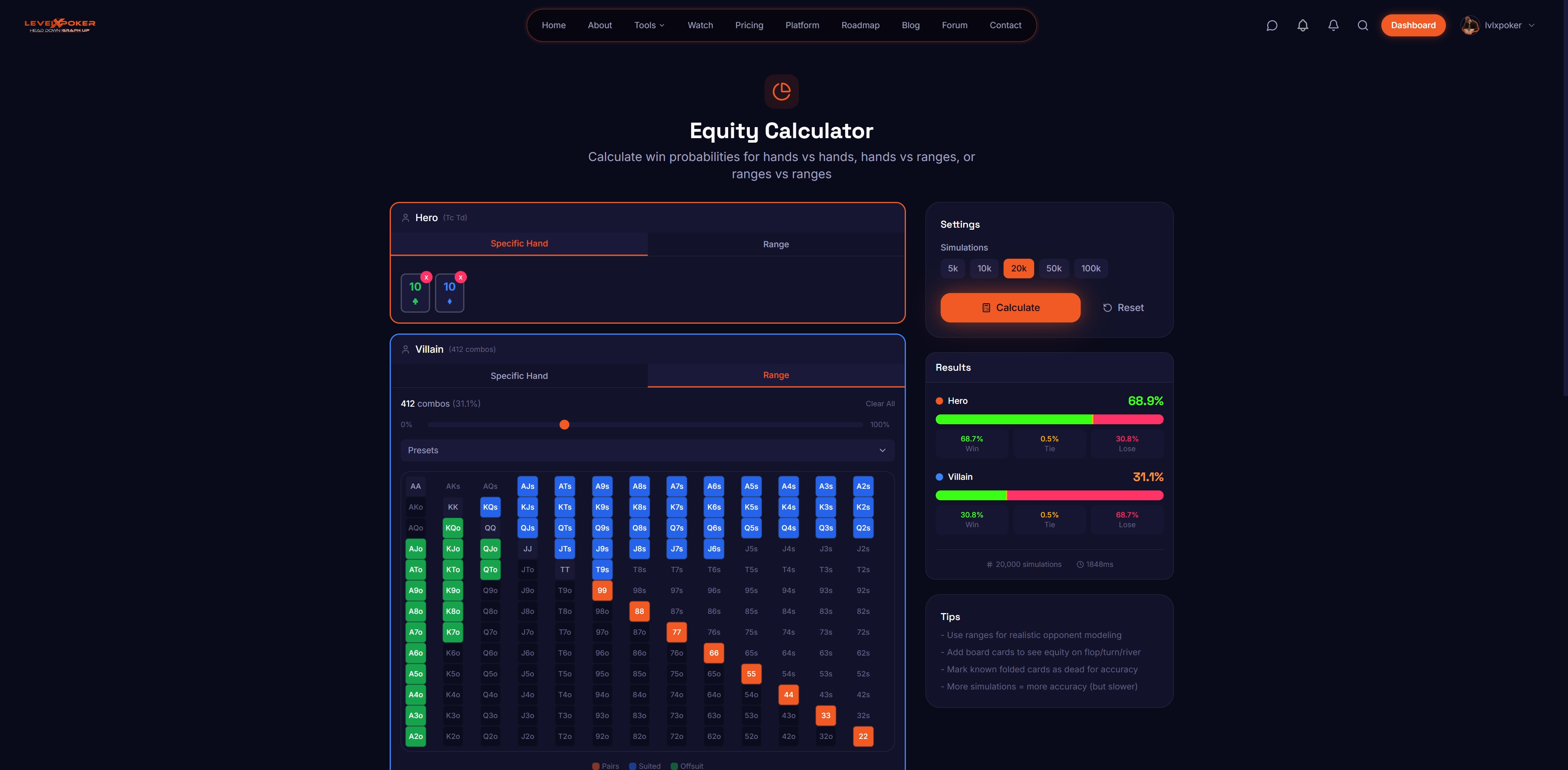
Everything you need for precise equity analysis
Four simple steps to precise equity calculations
Input specific hands or define ranges for each player
Add flop, turn, or river cards (or leave blank for preflop)
Get win/tie/lose percentages instantly
Use the numbers to inform calls, bets, and folds
Equity calculations turn "I think I'm ahead" into "I know I have 62% equity."
You have top pair weak kicker on the river. Against villain's check-call range, you have 58% equity—enough to value bet thin.
Your missed draw has 0% equity at showdown. But with the right blockers and fold equity, a bluff can still be +EV—if the math supports it.
Does AJo play well against a tight 3-bettor? Run the equity and see. Spoiler: often worse than you'd guess.
Run equity on hands where you felt uncertain. See if your calls and folds were mathematically correct.
Test how different hands perform against opponent ranges. Build calling and 3-betting ranges with math backing.
Understand how often your bluffs need to work based on equity. Balance value and bluffs with precision.
Run equity on hands before your coaching session. Come prepared with numbers, not just feelings.
Share equity calculations with your study group to anchor discussions in math, not opinions.
Quick-check equity before running expensive solver sims. Make sure your assumptions are in the right ballpark.
Each part of the system reinforces the others.
Use a tool page to get the math right
Save or copy the output into your study workflow
Track outcomes over time with session and bankroll logging
Learn faster by turning real hands into structured learning moments
Keep your community and feedback loop in one place
Use a tool page to get the math right
Save or copy the output into your study workflow
Track outcomes over time with session and bankroll logging
Learn faster by turning real hands into structured learning moments
Keep your community and feedback loop in one place
A simple, repeatable process for turning play into progress.
Focus on a single concept or decision type during your session.
Save a handful of hands where you felt uncertain about the right play.
Calculate pot odds and equity on your saved spots.
Document your takeaway about each spot in plain language.
Read your notes before you play again to reinforce the learning.
Your share of the pot based on how often you'd win if the hand went to showdown.
The set of hands a player could hold based on their actions. Example: "Top 10% of hands" or "any pair, AK, AQ."
The character of the community cards—wet (draw-heavy), dry (few draws), or somewhere between.
How much of your raw equity you actually capture, accounting for position and skill edge.
The value gained from making opponents fold hands with equity against you.
Your equity multiplied by the current pot size—what the pot is "worth" to you right now.
In real poker, you rarely know your opponent's exact hand—but you can narrow them to a range of likely holdings based on their actions. Calculating equity against ranges gives you realistic numbers that reflect actual game conditions, not just hand-vs-hand matchups.
Yes. The calculator handles multiway equity by distributing win/tie percentages across multiple players. Keep in mind that multiway pots increase variance and often require tighter ranges than heads-up situations.
Understanding equity helps you size bets correctly. If you have 70% equity, you can bet larger for value. If you're bluffing with 30% equity, you know how often villain needs to fold for your bet to be profitable. Equity is the foundation of bet sizing math.
The difference between winning and break-even poker is often a few percentage points. Knowing your equity—every time—changes everything.
Free to start. No credit card required.
Risk Advisory
Poker involves risk. Tools and education can improve decision quality, but outcomes still vary due to variance. Responsible bankroll management and realistic expectations are part of playing well.