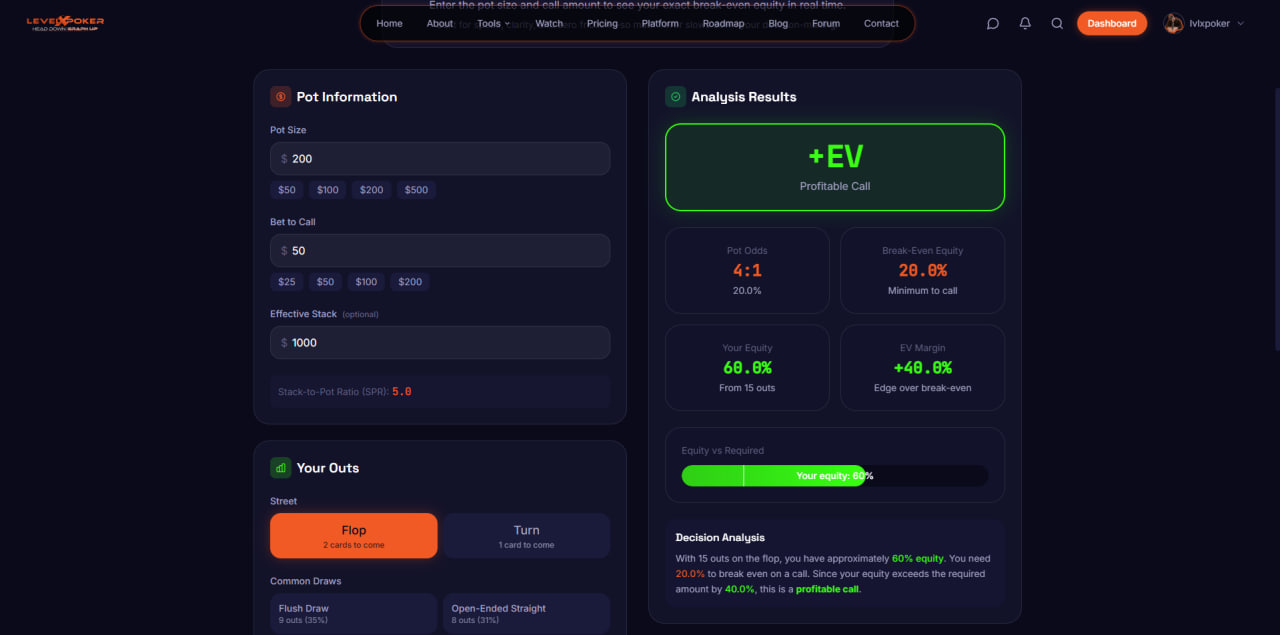
Calculate
Pot odds, equity, and tournament ICM—fast enough to use between hands.
Poker is a game of thin edges. Level X is built as a unified system for serious players: decision math, hand workflows, bankroll tracking, education, streams, and community working together under one account.
500+
Players Active
$1M+
Tracked Winnings
4.9
Average Rating
One Ecosystem, Not a Pile of Features
The tools don't just exist next to each other—they reinforce each other. Calculate a spot, save it, review it later, discuss it with others, and turn it into a study habit.
Your software has to be fast, clean, and reliable. We build with a simple standard: reduce friction, respect the player, and ship features that actually increase EV.
The Compounding Edge Loop
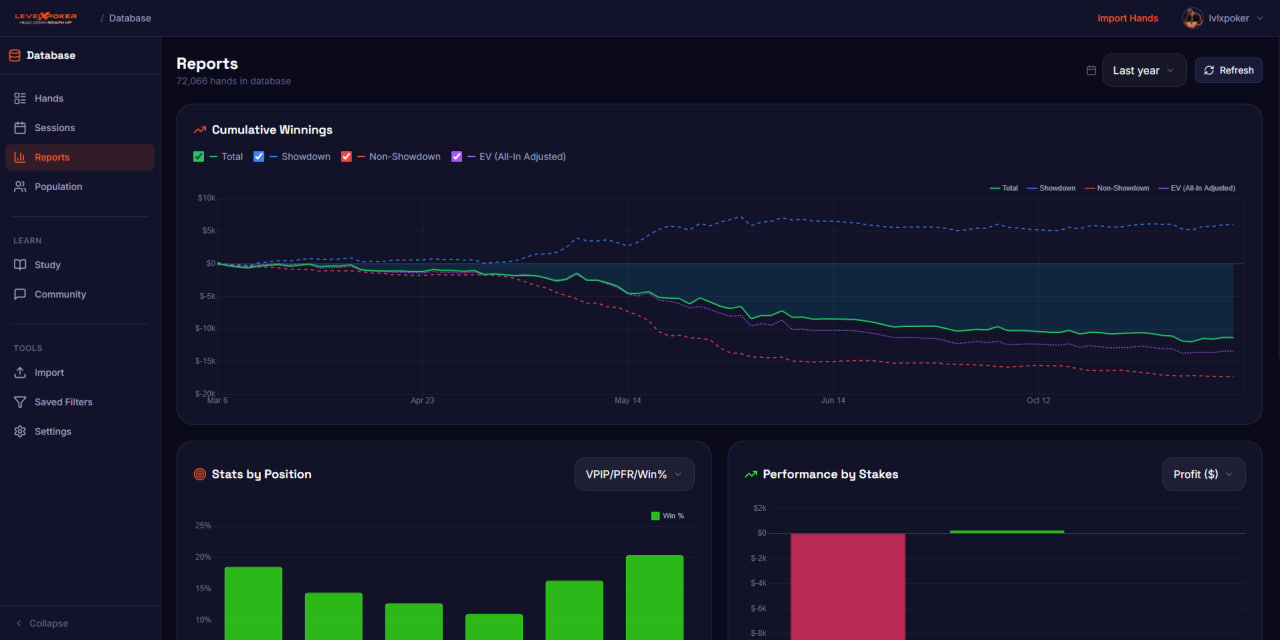
Play → Capture → Analyze → Store → Repeat—until good decisions become automatic.
Level X already covers the daily essentials that win-rate actually depends on.
Pot odds, equity, and tournament ICM—fast enough to use between hands.
Poker software has been fragmented for two decades. The long-term roadmap is convergence: tools + identity + study + media + gameplay infrastructure in one ecosystem.
Poker has spent the last twenty years trapped inside disconnected products, outdated workflows, and trust-based systems that were never designed to work together. We're building Level X to change that. Our mission is to bring the most important parts of modern poker—tools, identity, study, media, and gameplay infrastructure—into one connected ecosystem that feels fast, intentional, and built for serious players.
This is bigger than adding more software. We are building the foundation for a better poker experience: one account, one workflow, and one place where everything reinforces everything else. Instead of forcing players to bounce between calculators, spreadsheets, streaming platforms, trackers, communities, and future gameplay environments, Level X is designed to unify the loop so progress becomes easier to sustain and higher quality by default.
The long-term vision is simple: make poker feel like modern software should have felt years ago—integrated, reliable, creator-aware, and infrastructure-first. We want to reduce friction, reduce trust dependency, and raise the standard for what players should expect from the platforms they use every day. Level X is the foundation, X-Wave is the next layer, and together they are meant to create a single ecosystem where players can play, study, track, watch, and grow without living in a fragmented mess.
A single calculator can help you one time. A single video can teach you one concept. But improvement happens when you connect those moments into a loop:
You play.
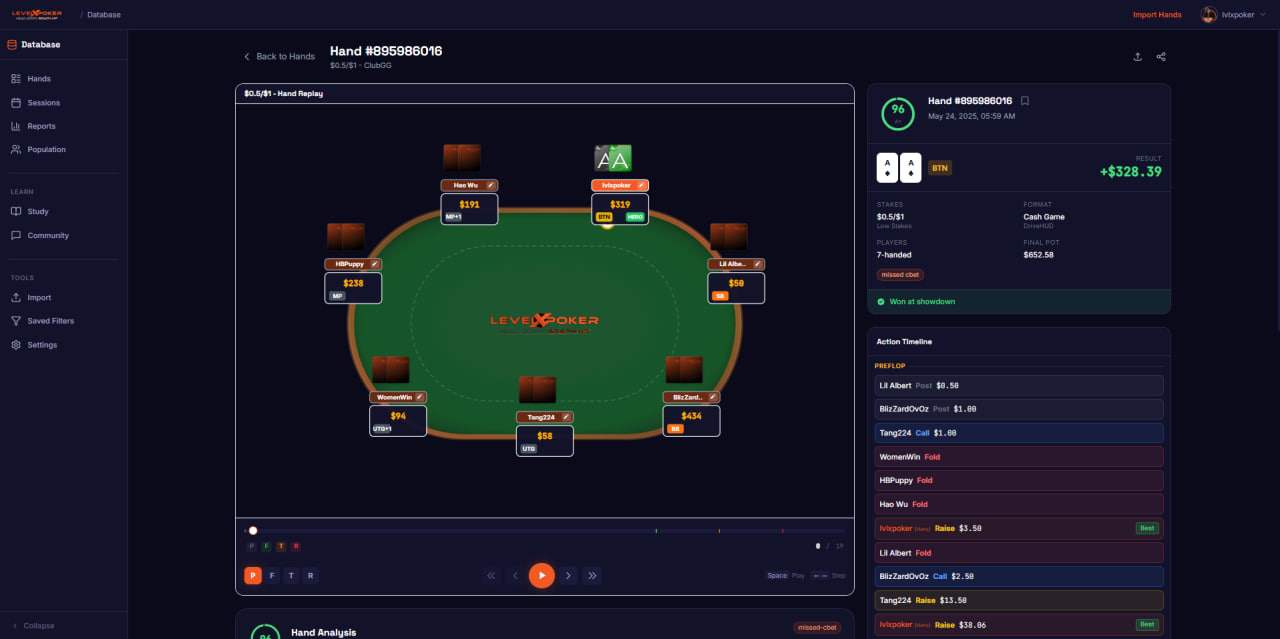
You capture the hands that mattered.
You run the math and remove the guesswork.
You store the insight where you'll see it again.
You repeat—until 'good decisions' become automatic.
Level X is built to keep that loop tight.
Level X meets you where you are and scales with your game.
You don't need a 50-tab study routine. You need the basics presented clearly: what price you're getting, what equity you have, and why your 'standard line' isn't always standard. Start with the core tools and the community.
Your advantage comes from volume *and* decision quality. You want speed, consistency, and systems that reduce mistakes. Level X is built to save time and eliminate friction—so you can spend more energy on the decisions that matter.
You need more than content. You need tracking, feedback loops, and a structure that survives variance. Paid tiers unlock deeper features, member streams, and higher-touch coaching pathways designed to pay for themselves when used correctly.
Each part of the system reinforces the others.
Use a tool page to get the math right
Save or copy the output into your study workflow
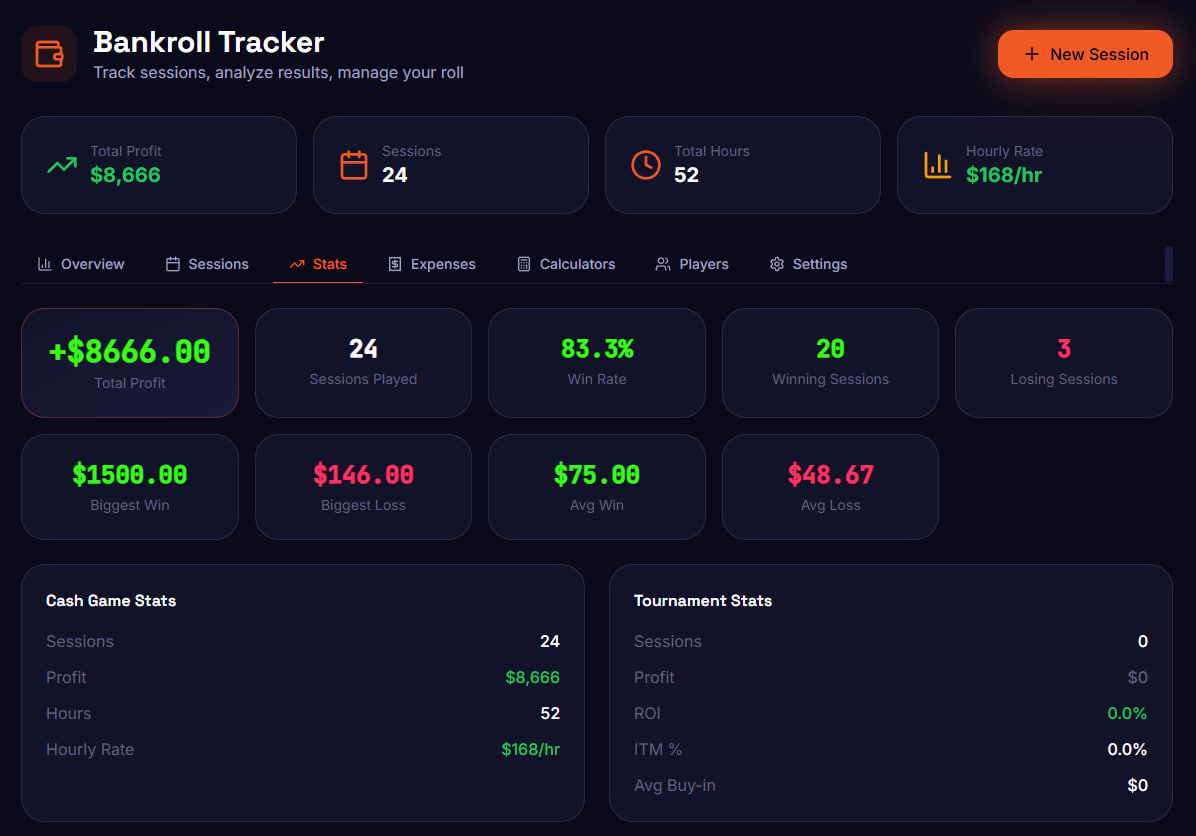
Track outcomes over time with session and bankroll logging
Learn faster by turning real hands into structured learning moments
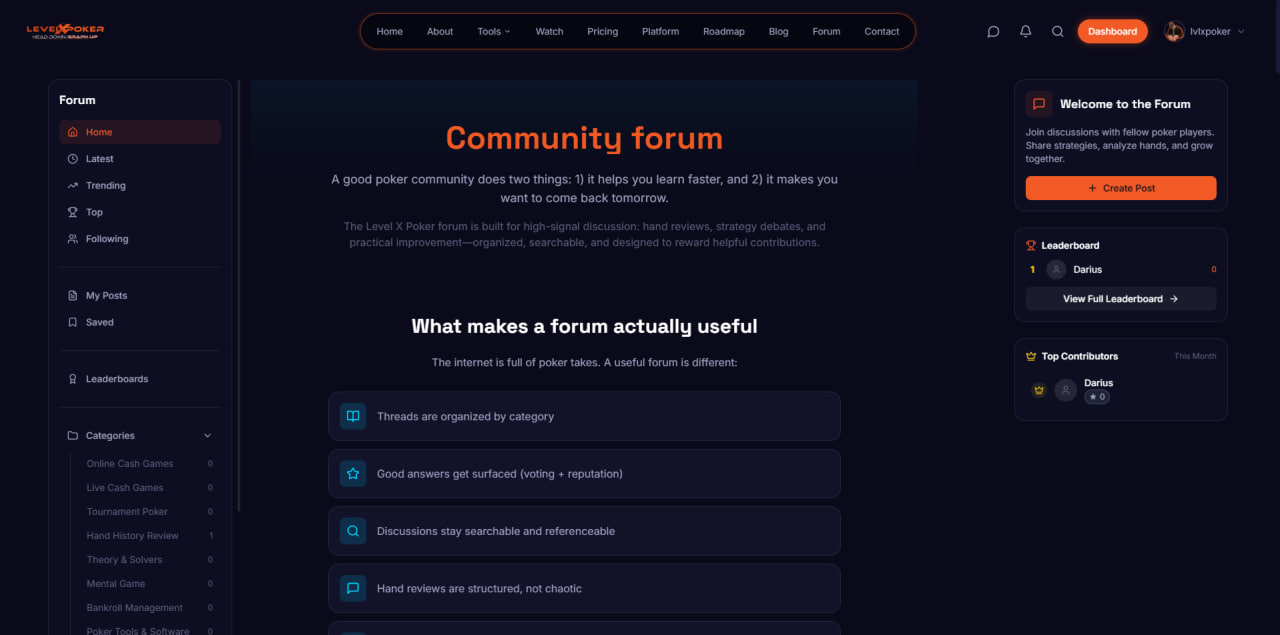
Keep your community and feedback loop in one place
Use a tool page to get the math right
Save or copy the output into your study workflow
Track outcomes over time with session and bankroll logging
Learn faster by turning real hands into structured learning moments
Keep your community and feedback loop in one place
A lot of players 'study' by bouncing between random videos and solver screenshots. It feels productive, but it doesn't always translate to better decisions. A cleaner loop looks like this:
For example: defend the big blind better.
Save hands where you felt uncertain.
Calculate pot odds and equity so you're not anchored to feelings.
What you thought, what you missed, and what you'll do next time.
Read your notes before you play again to reinforce the learning.
The point isn't to study more. The point is to study *sharper*—and keep the loop short enough that you repeat it.
The average amount you expect to win or lose from a decision if you repeated it many times. EV is why you can play well and still lose today—and why bad players can win short-term.
Your share of the pot on average at showdown, given the hands/ranges involved. Equity answers 'how often do I win if we run it out?'
The price you're being laid to call. Pot odds tell you the break-even equity you need to continue profitably.
Extra money you can win on later streets when you hit. Pot odds is the floor; implied odds is the upside.
Independent Chip Model. A way to convert tournament chip stacks into real-money equity based on payout structures. It explains why 'chip EV' and 'money EV' can disagree.
The natural swinginess of outcomes in poker. Variance is not unfairness; it's the tax you pay to play a high-luck, high-skill game.
Between hands, verify pot odds or equity so you don't compound guessing.
Convert a handful of hands and review them with one objective.
Bring clean hands and a clear question so feedback is useful.
Use ICM to avoid 'felt right' punts near pay jumps.
Track sessions and expenses so you know true profit and risk posture.
Build notes on recurring opponents and patterns so you stop relying on memory.
Risk Advisory
Poker involves risk. Tools and education can improve decision quality, but outcomes still vary due to variance. Responsible bankroll management and realistic expectations are part of playing well.
The rule is simple: if the next tier doesn't increase your EV, you don't need it.
Free
Real value, not a crippled demo. Core tools and community access.
Enthusiast
Removes friction for players who study consistently.
Pro
Built for high-volume players who want deeper analytics and member content.
Crusher
White-glove access for professionals who treat poker like a business.
No credit card required. Calculate, track, study, and connect—without juggling five different products.