Pre-Session Warm-Up
Review 3-5 hands from similar spots before you play. Prime your decision-making for the session ahead.
Store, search, and analyze every hand you play. Find leaks, track progress, and study your game.
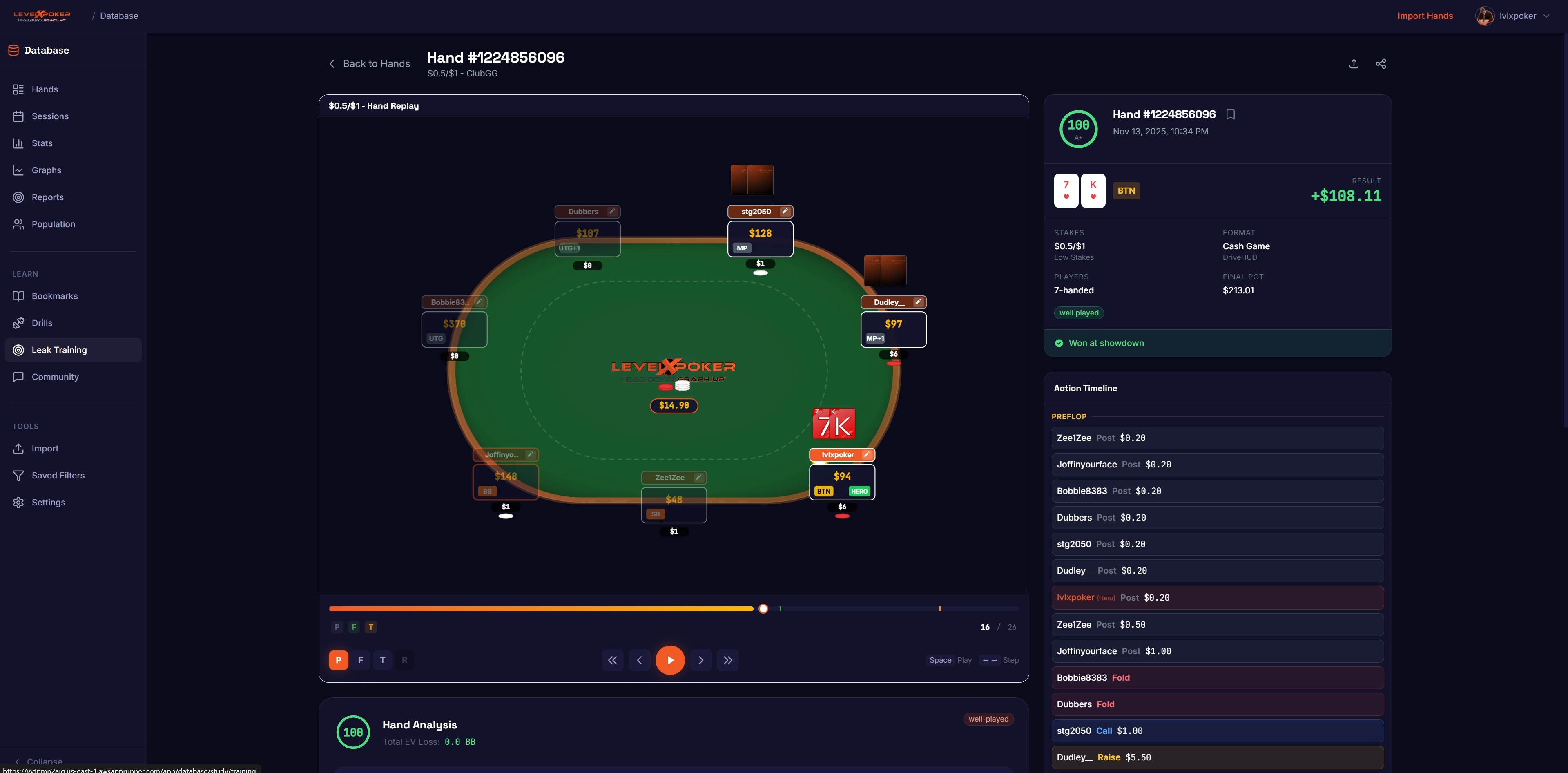
Turn hand history into competitive edge
Four steps to poker knowledge management
Convert or upload hand histories from any major site or format
Apply tags and notes while hands are fresh in your mind
Find exactly the hands you need with powerful filters
Turn patterns into insights, insights into better play
The difference between "I think I play that spot well" and "I know my win rate there."
Filter for hands where you defended the big blind. See your win rate by position of raiser, stack depth, and action taken. Find the spots where you're bleeding money.
Search for hands tagged "river bluff" and filter by result. What do your successful bluffs have in common? What about the ones that got picked off?
Pull your 5 most confusing hands from the last month. Share them with your coach before the session so you can dive straight into analysis.
Review 3-5 hands from similar spots before you play. Prime your decision-making for the session ahead.
Filter for hands where you lost the maximum. Look for patterns—are you overplaying draws? Paying off too often?
Pull interesting hands before your coaching call or group session. Come with questions, not just complaints.
How do you perform from the blinds vs. the button? Filter by position and see the truth in your numbers.
Search for hands against specific opponents. Build notes backed by actual hand histories, not just memory.
Filter for final table hands or bubble situations. Study your high-pressure decision-making.
Each part of the system reinforces the others.
Use a tool page to get the math right
Save or copy the output into your study workflow
Track outcomes over time with session and bankroll logging
Learn faster by turning real hands into structured learning moments
Keep your community and feedback loop in one place
Use a tool page to get the math right
Save or copy the output into your study workflow
Track outcomes over time with session and bankroll logging
Learn faster by turning real hands into structured learning moments
Keep your community and feedback loop in one place
A sustainable practice for turning hand history into improvement.
Don't let hands pile up. Fresh context makes tagging faster and more accurate.
You don't need to review everything. Focus on hands that made you think.
Pick one theme (e.g., 3-bet pots) and filter your database. Look for patterns.
Take a tagged hand and calculate whether your line was actually correct.
Document what you learned. Next session, apply it.
A record of all actions in a poker hand—cards dealt, bets made, outcomes. The raw data your database stores and analyzes.
Criteria for narrowing your hand search—by position, stake, outcome, action type, or custom tags.
A label you apply to hands for later retrieval. Examples: "bluff gone wrong," "thin value," "ICM spot."
A saved hand state you can revisit, share, or use as a starting point for equity calculations.
Any hand you convert or import gets saved to your database. Live hands you enter manually, online hands from major sites, tournament hands with full ICM context—everything lives in one searchable place.
A HUD shows stats during play. The database is for after—searching, filtering, studying, and finding patterns across your entire history. They complement each other; this isn't a replacement for real-time tracking.
Yes. Export individual hands or create shareable links. Privacy controls let you decide what information is visible—you can anonymize stakes, usernames, or other details before sharing.
The best players don't rely on memory. They build systems. Your hand database is where pattern recognition begins.
Free to start. No credit card required.
Risk Advisory
Poker involves risk. Tools and education can improve decision quality, but outcomes still vary due to variance. Responsible bankroll management and realistic expectations are part of playing well.